To estimate how many employees for 24/7 coverage your business needs, start by calculating the total weekly coverage hours and each employee’s available working hours.
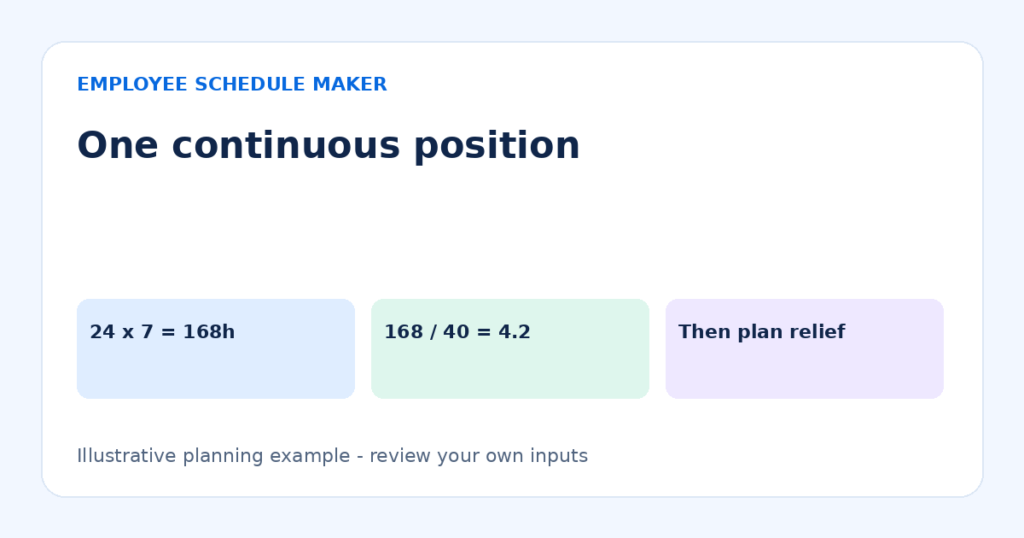
One continuously staffed position needs 24 × 7 = 168 coverage hours each week. Divide those hours by the realistic weekly coverage contribution per employee to get a starting headcount. Then add the effect of breaks, leave, training, handovers and absence. The arithmetic gives a capacity estimate, not a complete or legally compliant roster.
This guide shows how to calculate a 24/7 staffing estimate without confusing coverage with paid hours or choosing a shift pattern too early. All examples are fictional. Use your own operating requirements and verify employment, safety and other applicable obligations separately.
Define the position that must remain covered
Start with a role and location. “One service position at all times” is different from “one qualified lead plus two service positions.” If roles cannot substitute for one another, calculate them separately. If demand varies, use a coverage matrix rather than multiplying every period by the highest headcount.
For one position continuously covered, the requirement is 168 position-hours per week. For two positions continuously covered, it is 336. This is not the same as employing one or two people: the positions persist while employees rotate through assignments.
Calculate the theoretical minimum
Suppose a fictional employee could contribute 40 hours of actual position coverage per week. For one continuous position, 168 ÷ 40 = 4.2. Four people would supply only 160 hours, leaving eight uncovered. Rounding up gives five people as a theoretical capacity starting point, before reviewing whether their available shifts can fit the pattern.
The 40-hour input is an assumption, not a recommended workload or a legal threshold. It also assumes every one of those hours covers the required position. If some time is spent in training, meetings or uncovered breaks, the useful coverage contribution is lower.
| Coverage contribution per employee | 168 divided by contribution | Rounded-up starting count |
|---|---|---|
| 40 hours | 4.20 | 5 |
| 36 hours | 4.67 | 5 |
| 32 hours | 5.25 | 6 |
These rows are scenarios, not staffing recommendations. A rounded count can still fail if everyone is unavailable for the same night or if only one employee has the required qualification.
Keep elapsed time, paid time and coverage distinct
Imagine two 12-hour assignments covering a day: 07:00–19:00 and 19:00–07:00. The elapsed assignments total 24 hours. If each includes a 30-minute unpaid break, the paid total is 23 hours. If the position cannot be left unattended, somebody must provide the missing one hour of coverage.
Over seven days, those unpaid breaks remove seven hours from the primary workers’ coverage if they leave the position for each break. Relief must be planned at actual times. Another worker’s unpaid-break deduction does not magically create coverage elsewhere.
The paid-hours calculators can verify the deduction. They cannot determine whether a position is attended or whether a break arrangement is appropriate. Record a timed relief plan separately; the editor stores the length of unpaid breaks rather than their placement.
Add operational allowances without inventing a percentage
Instead of applying a generic “staffing buffer,” list the work that reduces coverage capacity. Include planned leave, required training, meetings away from the position, handover overlap and foreseeable absences using information appropriate to your operation. State each assumption and the period it covers.
For example, if your planning assumption is that each employee contributes 36 coverage hours in the relevant week, use 36 in the divisor rather than calling all paid time coverage. If contribution varies significantly across weeks, review a longer period and individual peak weeks. A yearly average can conceal a week with several simultaneous absences.
Choose a pattern after checking capacity
Possible patterns include three eight-hour blocks, two twelve-hour blocks or another arrangement suited to the work. None is automatically appropriate. Longer shifts reduce the number of daily handovers but change fatigue, relief and availability considerations. Shorter shifts require more changeovers. Assess the actual tasks and conditions rather than choosing solely for an attractive grid.
A 2-2-3 rotation is one way to arrange 12-hour assignments across a repeating fortnight. A four-team diagram may cover the base position on paper, yet still provide no spare capacity for breaks or absence. The rotation pattern and the staffing allowance are separate decisions.
Test the proposed roster interval by interval
- List every required position and qualification.
- Map all seven days, including midnight boundaries.
- Assign named, available employees to each block.
- Place handovers and relief at actual times.
- Check the same employee is not double-booked.
- Review weekly hours, neighboring weeks and the practicality of the work pattern.
- Test what happens when a planned absence occurs.
Use a night-shift or rotating template as an example to edit, not as proof of suitable staffing. The schedule maker helps record shifts and paid totals, but it does not optimize a 24/7 workforce or assess fatigue.
A two-position example
Suppose you need two service positions continuously and estimate 36 coverage hours per employee per week. The requirement is 2 × 168 = 336 hours. Dividing by 36 gives 9.33, so the rounded-up starting count is 10 employees for that role. If you also need a separate lead at all times, calculate that lead requirement separately rather than counting the same ten employees twice.
Ten people at 36 contribution hours offer 360 hours of theoretical capacity, 24 more than the 336-hour requirement. That difference does not guarantee a workable roster. Check whether the extra capacity is available during the intervals that need it and whether the assumed contributions already account for the relevant absences.
Stress-test the estimate before naming it a plan
Take the proposed headcount and remove one person for a planned absence in a test week. Identify the exact uncovered blocks rather than simply subtracting a weekly total. A team may have spare daytime capacity while lacking a qualified night worker. That is a distribution problem, even if the aggregate capacity appears sufficient.
Next test a training session that removes a required worker from the position for two hours. Decide who covers those hours and whether that person still covers their own work. Counting the same worker as both trainer and active coverage can make a plan look complete when it is not.
Finally check the handover assumption. If both the outgoing and incoming worker need fifteen minutes together, those minutes add scheduled overlap beyond the base 168 position-hours. Record how many handovers occur and which roles participate. Do not add an arbitrary allowance without explaining its purpose. These small tests turn a capacity estimate into questions you can resolve before publishing named shifts, while keeping clear which assumptions remain uncertain.
Frequently asked questions
Can four employees cover one 24/7 position?
Four employees averaging 42 coverage hours each provide 168 hours arithmetically. That leaves no extra coverage capacity in the simple model. Whether any such arrangement is appropriate requires a separate review of the work, breaks, absence, qualifications and applicable requirements.
Should I round 4.2 down to four?
No, not if each person contributes only the assumed 40 coverage hours. Four gives 160, which is below 168. Rounding up is only the starting capacity step, not the final roster.
Does the tool calculate required headcount?
No. This guide provides the method. The editor calculates entered shift hours and identifies certain overlaps; managers supply the coverage requirements and staffing decisions.
Document the assumptions
Write down the positions, coverage hours and contribution assumption beside the draft roster. Review them whenever operating hours, roles or availability change. A transparent estimate is easier to correct than an unexplained headcount.