Staff coverage planning means matching the number and skills of available workers to the work expected in each time interval. Start with demand by hour or half-hour, translate it into role requirements, and then test whether the proposed shifts actually cover those requirements. A weekly total alone cannot show whether enough people are present during your busiest hour.
This guide uses a fictional small café to demonstrate the method. The numbers are planning assumptions, not industry benchmarks. Use your own observations and operating requirements, then enter the resulting shifts in the employee schedule maker.
Start with work, not last week’s roster
List opening, service and closing tasks separately. A shop may have quiet sales at 08:30 but still need deliveries checked and tills prepared. A restaurant may need preparation before customers arrive. For each period, identify the role, required skills and whether the work can move to a quieter time.
Review several comparable trading days if you have records. Note events, deliveries, appointments and unusual promotions rather than averaging them away. A single busy Saturday does not establish every future Saturday’s demand. If records are limited, observe a few intervals, state your assumptions and review them after the schedule is used.
Build a small coverage matrix
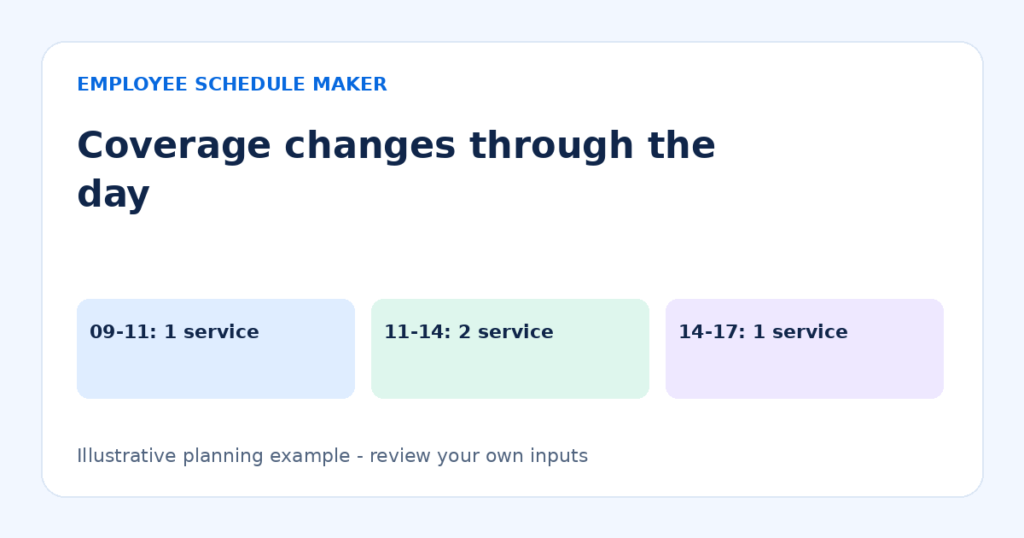
In this fictional example, the café requires one service worker throughout trading and an additional service worker for the lunchtime rush. A separate lead is present during preparation and trading. The table counts positions, not named employees.
| Time | Service positions | Lead positions | Reason |
|---|---|---|---|
| 08:00–09:00 | 0 | 1 | Preparation and opening |
| 09:00–11:00 | 1 | 1 | Regular service |
| 11:00–14:00 | 2 | 1 | Expected lunch demand |
| 14:00–17:00 | 1 | 1 | Regular service and close |
The service requirement is 2 hours × 1 position, plus 3 hours × 2 positions, plus 3 hours × 1 position: 11 service position-hours. The lead requirement is 9 position-hours. Combined required coverage is 20 position-hours. This calculation excludes relief, handovers and any extra closing time; those must be added explicitly where needed.
Translate positions into proposed shifts
Give the fictional lead Noor an 08:00–17:00 assignment, Maya service from 09:00–17:00, and Eli service from 11:00–14:00. The elapsed scheduled time is 9 + 8 + 3 = 20 hours. It appears to match the matrix, but the apparent fit assumes all three people are available for every minute of their assignments.
If Noor and Maya each take a 30-minute unpaid break, the paid-hours total becomes 19. The team also loses one lead position for 30 minutes and one service position for 30 minutes unless another qualified person covers. Deducting break duration in a calculator does not place relief into the roster. This is why paid hours, elapsed shifts and coverage hours answer different questions.
Use intervals to find the actual gap
Check the roster at every shift start, shift finish and planned break boundary. For each interval, count people who are present, available and qualified for the required role. A person should not be counted in two positions simultaneously unless the work genuinely allows that and the assumption has been checked.
For example, moving Maya’s break to 14:00 does not solve coverage if Eli finishes at 14:00 and Maya is the only remaining service worker. Extending Eli to 14:30 could cover that service break, but it still does not cover Noor’s lead duties. Resolve each role separately rather than hiding the problem in the total.
A repeatable planning process
- Choose an interval. Thirty minutes is often a manageable starting point for a small operation. Use shorter intervals where demand changes quickly.
- Write the minimum role requirement. Include opening and closing tasks and explain assumptions.
- Check availability. Use a dated employee availability record, including role limits and approved absences.
- Assign the hard-to-cover periods first. Identify the qualified lead or specialist before filling flexible work.
- Add handovers and break relief. Record their timing outside the tool if required; the editor stores break duration, not a timed break plan.
- Review the whole day. Check the quiet edges as carefully as the peak.
- Compare the plan with actual experience. Adjust the next roster using observations rather than copying an untested assumption.
Use hourly totals carefully
The paid-hour calculators help confirm shift arithmetic. They cannot tell you how many transactions one worker can handle, whether a role needs specialist training, or how many staff your particular business should have. Choose those inputs from your operation and explain them to whoever reviews the roster.
When estimating a cost, distinguish scheduled paid hours from the employee’s actual recorded work. This site’s planning totals are not a payroll record. If work runs late or an unpaid break is not actually taken, a manager must review the real circumstances through the appropriate timekeeping process.
Plan for changes without pretending to predict everything
Prepare a response for a short-notice absence or an unexpectedly busy period. Identify whom you may contact, which tasks can move and when to reduce or change service. Do not label a person “backup” unless the arrangement is clear to them. The roster cannot guarantee attendance or eliminate uncertainty.
A useful review note might say: “Tuesday lunch required a third service person from 12:00 to 12:30 because of a group booking.” That is more actionable than “Tuesday felt understaffed.” Keep personal information out of shared notes and use a consistent date and interval.
Common coverage mistakes
- Using a daily headcount. Five employees working at different times do not mean five are available at noon.
- Counting unpaid breaks as coverage. Check the planned timing and qualified relief.
- Ignoring role mix. Three available service employees do not automatically replace a required lead.
- Stopping at closing time. Include cleanup, reconciliation or handover work when it is needed.
- Scheduling only to an average. Inspect busy intervals and the reasons behind exceptions.
Review one actual trading day
After using the fictional Tuesday plan, compare the expected busy period with what happened. Record a few concrete observations: which interval had a queue, which task was delayed, whether a delivery coincided with lunch, and whether the planned break relief was available. Keep this review about work and intervals rather than judging an employee from a single unusual event.
If demand was quiet at 11:00 but heavy at 13:30, moving the second service assignment may be more useful than increasing the whole day’s hours. Test the revised start and finish against availability and the closing workload. A change that helps the rush can still create a gap at the edges.
Retain the original assumption beside the revised one so you can explain the decision next week. For example: “Keep two service positions until 14:30 on booking days; review after the next two comparable dates.” That is a testable local planning decision. It is more useful than treating a general staffing ratio from another business as a reliable rule for your café.
Frequently asked questions
How do I calculate coverage hours?
For each interval, multiply its duration by the required number of positions, then sum the intervals. Keep separate totals for roles that cannot substitute for one another. Add relief requirements explicitly.
Can overlapping shifts be useful?
Yes. Different employees’ shifts may deliberately overlap for demand or handover. An overlap warning for the same employee is a different issue: it may indicate double-booking. Review the people, roles and actual time boundaries.
Should I copy last week’s coverage?
Use it as a starting point only. Check events, availability, absences and observed demand. See the weekly scheduling guide for the broader review sequence.
Put the matrix beside the roster
Choose a restaurant, retail or small-business template, assign realistic shifts and compare each interval with the coverage matrix. A roster becomes easier to defend and improve when you can explain which work each assignment covers.