A 2-2-3 rotating shift schedule usually means working two days, taking two days off, and working three days, followed by the complementary pattern in the next week. With 12-hour assignments, a worker has seven shifts across 14 days: 84 elapsed hours before breaks. The pattern can be used in continuous operations, but the schedule alone does not provide break relief or absence cover.
This guide explains a fixed day/night example with four fictional teams. It does not recommend 12-hour shifts for every workplace, establish legal limits or promise better health or productivity. Assess the actual work and applicable obligations before adopting a rotation.
Read the 14-day pattern
For Pattern A, Week 1 has work on Monday, Tuesday, Friday, Saturday and Sunday. Week 2 has work on Wednesday and Thursday. Pattern B works the opposite dates. Together the two patterns cover every date once for a given shift block.
| Pattern | Mon | Tue | Wed | Thu | Fri | Sat | Sun |
|---|---|---|---|---|---|---|---|
| A, Week 1 | W | W | — | — | W | W | W |
| B, Week 1 | — | — | W | W | — | — | — |
| A, Week 2 | — | — | W | W | — | — | — |
| B, Week 2 | W | W | — | — | W | W | W |
Repeat the full fortnight, not just Week 1. Repeating the five-shift week for Pattern A would create a different workload. Label the dates and the cycle week explicitly so that a calendar month boundary does not reset the rotation accidentally.
Apply day and night blocks
In a simple fixed-block example, Team A follows Pattern A on days, 07:00–19:00. Team B follows Pattern B on days. Team C follows Pattern A on nights, 19:00–07:00 the following day. Team D follows Pattern B on nights. Each team represents the people needed for its block, not necessarily one person.
For each start date, either A or B supplies the day block, and either C or D supplies the night block. That gives a base 24-hour pattern. It does not include additional overlap for handover or relief for an employee who leaves the position during a break.
The word “rotating” can refer to rotating workdays, rotating day/night blocks, or both. This example rotates workdays while keeping teams on fixed day or night blocks. Switching between days and nights would require a separately designed and reviewed transition; it is not silently included here.
Check hours in each week
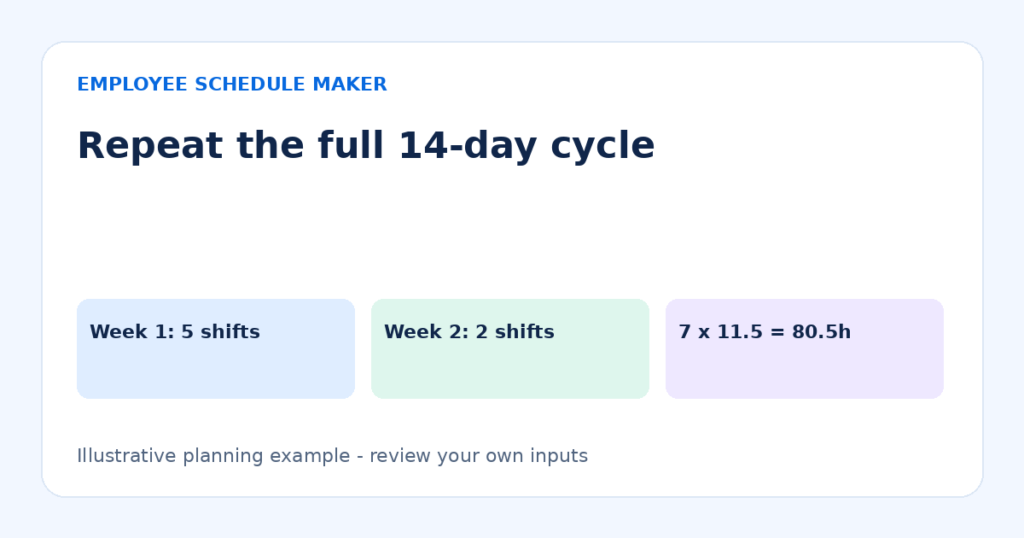
Pattern A has five 12-hour shifts in Week 1 and two in Week 2. That is 60 elapsed hours followed by 24, totaling 84. With a 30-minute unpaid break in every shift, each shift is 11.5 paid hours: Week 1 is 57.5, Week 2 is 23, and the fortnight total is 80.5.
The arithmetic average is 40.25 paid hours per week, but the individual weeks remain 57.5 and 23. Do not treat the average as permission to average hours for payroll or other legal purposes. Check the applicable rules separately. Pattern B has the same fortnight total with the high and low weeks reversed.
Use the paid-hours calculators to verify duration inputs and the two-week planning workflow to review both weeks. The current editor displays one week at a time, so keep both weekly exports available for comparison.
Why four teams are not automatically enough
The four-team diagram assigns every base day and night block. If each block needs one person and every shift includes a 30-minute unpaid break away from the position, the primary assignments leave one hour per day needing relief. Across a fortnight that is 14 hours of relief coverage, before leave or absence.
If the operation needs a lead and two service employees at all times, a “team” must supply that role mix. Do not count an off-duty team as freely available cover without an explicit arrangement. Check the 24/7 headcount calculation to distinguish base pattern capacity from realistic coverage contribution.
Build and review a dated example
- Choose a Monday as the start of Cycle Week 1.
- Assign the day and night teams and list their required skills.
- Enter Pattern A and Pattern B for Week 1.
- Navigate to the next week and enter the complementary assignments.
- Review unpaid-break deductions and separately plan timed relief.
- Check Sunday-night finishes against Monday assignments in the following week.
- Review the workload pattern and any proposed day/night transitions before use.
The 2-2-3 template provides an editable starting example. Read its instructions and verify which dates and teams it includes. Opening a template in the editor requires confirmation because it replaces the browser workspace. Download a JSON backup first if you need to preserve current work.
Common mistakes
- Repeating only seven days. Preserve the complete 14-day cycle.
- Confusing a team with one employee. Define the required role mix within each block.
- Calling the average the weekly total. Show the high and low weeks separately.
- Ignoring breaks and handovers. Base shift boundaries do not establish continuous staffed coverage.
- Switching day/night blocks casually. Review transitions as a separate planning decision.
Follow the cycle through a calendar boundary
A repeating fortnight does not restart because a new month begins. Write “Cycle Week 1” or “Cycle Week 2” beside each actual Monday in your planning record. If the final Sunday of a month belongs to the five-shift week, the next Monday begins the complementary week even when a monthly calendar makes the pattern look disconnected.
Check one named night worker through that transition. A Sunday 19:00–Monday 07:00 assignment belongs to Sunday’s start date in this tool. Do not add a Monday morning assignment merely because Monday’s cell appears empty in the next week. The overnight work extends into that date, and the wider work pattern still needs review.
When a team member is absent, retain the underlying cycle and record the actual replacement assignment separately. Copying a substitute’s exceptional week indefinitely can accidentally create a new pattern with different hours. After a substitution, compare both the absent employee’s roster and the replacement’s surrounding assignments.
Before sharing a new cycle, verify all fourteen dates against the pattern table, then inspect the following Monday as a boundary check. This is especially useful when a schedule is printed one week at a time: the first page can look correct while the connection to the second page is wrong.
Frequently asked questions
Can you give an example of a rotating shift schedule?
Use the dated 2-2-3 example above: Pattern A works Monday, Tuesday and Friday through Sunday in Week 1, then Wednesday and Thursday in Week 2. Pattern B does the opposite. Assign separate day and night teams to those patterns and review actual relief and availability. The example rotates workdays; it does not automatically move employees between day and night blocks.
Is a 2-2-3 schedule the same as any four-team schedule?
No. Four teams can follow different cycles. The defining feature here is the complementary two-on, two-off, three-on pattern across two weeks. Names for shift systems can vary, so inspect the actual dated assignments.
Does every employee get alternate weekends off?
In the simple complementary pattern shown, each pattern works one full weekend and has the next off. Exceptions, leave and substitutions can alter that outcome. Check the named roster rather than relying only on the pattern label.
Can the editor assess fatigue or compliance?
No. It records shifts and calculates entered wall-clock durations. It is not a fatigue model or a legal compliance checker. Use qualified guidance appropriate to the operation.
Test before adopting
Walk through a complete fortnight with named employees, required roles, relief and absence scenarios. A rotation is useful only if its real assignments are workable, not merely because the pattern fills a table.